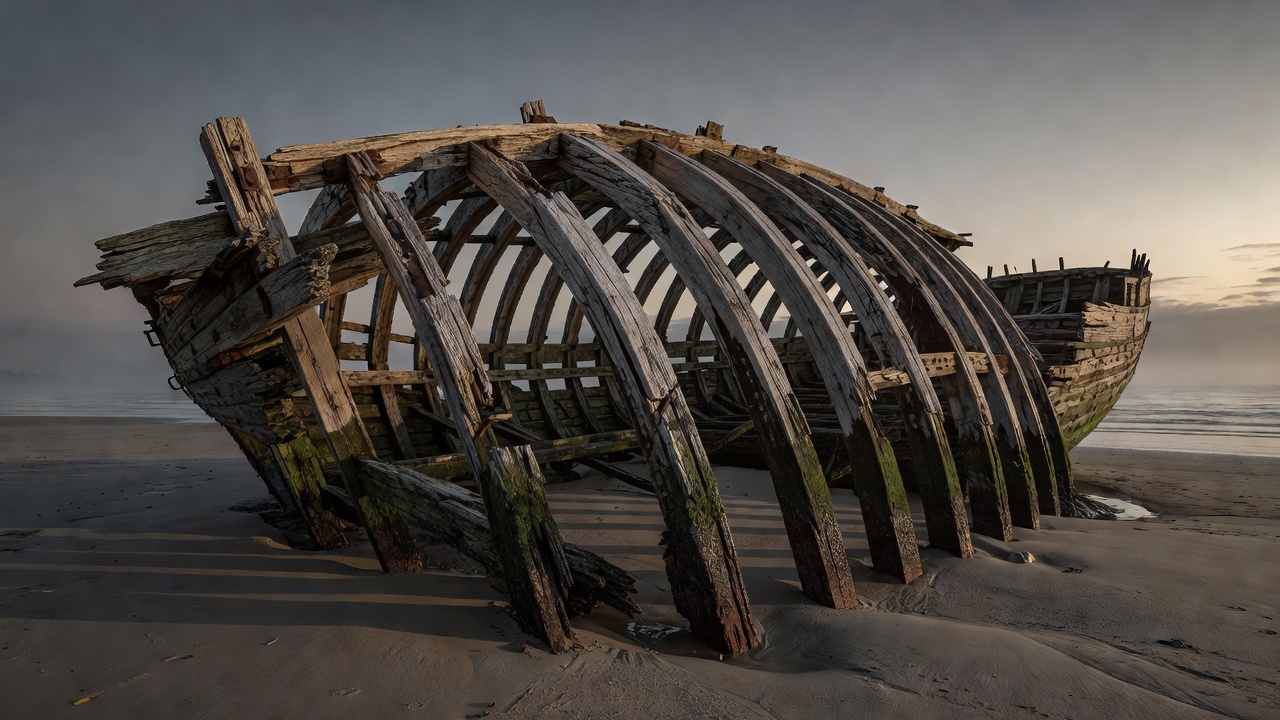
The Mary Rose was the pride of King Henry VIII's Tudor navy. Unlike the 20th-century steel behemoths in our archives, the Mary Rose was a wooden carrack. Her sudden sinking in 1545 and subsequent burial in the silt of the Solent preserved a cross-section of 16th-century life with unparalleled fidelity. Her eventual raising in 1982 stands as one of the most complex and celebrated achievements in maritime archaeology.
Design and Evolution of the Tudor Fleet
Built in Portsmouth between 1510 and 1511, the Mary Rose represented a transitional phase in naval warfare. Early 16th-century naval battles were primarily boarding actions, where high 'castles' at the bow and stern allowed archers to fire down upon enemy decks. However, by 1536, the ship was substantially rebuilt to accommodate broadside cannons.
This rebuild introduced gun ports cut directly into the hull close to the waterline. While this allowed the ship to carry much heavier bronze and iron cannons, it created a fatal vulnerability: if the ship heeled over too far while the gun ports were open, water would flood the lower decks immediately.
Vessel Specifications
- Displacement: Approx. 700 tons (after 1536 rebuild)
- Crew: Up to 400 mariners, soldiers, and gunners
- Armament Mix: Heavy muzzle-loading bronze cannons, breech-loading wrought iron guns, and longbows.
- Construction: Carvel planking over massive oak frames.
The Battle of the Solent
On July 19, 1545, the English fleet engaged a massive French invasion force in the Solent, the strait separating the Isle of Wight from mainland England. According to historical accounts, as the Mary Rose turned to fire a broadside, a sudden gust of wind caught her sails. The ship heeled heavily to starboard. Water surged through the open lower gun ports, and within minutes, the flagship went down with almost all hands.
Archaeological Excavation and Preservation
Because she sank in shallow coastal waters, tidal currents quickly filled the starboard side of the hull with fine silt. This silt created an anaerobic (oxygen-free) environment that preserved the timber and thousands of artifacts—from longbows and navigation instruments to wooden combs and leather shoes. The exposed port side eroded away entirely over the centuries.
Discovered by side-scan sonar in 1971, the wreck site was meticulously excavated by a team of divers over a decade. In October 1982, a custom-built lifting frame was used to cradle the remaining hull section and raise it to the surface in a single piece.
Preserving the waterlogged oak was a massive scientific challenge. The timber was initially sprayed constantly with chilled fresh water to stop it from drying and warping. Over several decades, it was systematically sprayed with polyethylene glycol (PEG) to replace the water within the wood's cellular structure, before finally being freeze-dried. Today, the starboard hull resides in a specialized museum in Portsmouth, serving as a primary source for Tudor history.