Before the outbreak of World War I, the rivalry between British and German ocean liners pushed marine engineering to unprecedented speeds. The RMS Lusitania, operated by the Cunard Line, was one of the fastest and most luxurious ships on the transatlantic run. However, her fame is largely defined by her destruction by a German U-boat in 1915, an event that sharply shifted American public opinion against Germany.
Engineering for Speed
Built at the John Brown & Company shipyard in Scotland and launched in 1906, the Lusitania was designed with a singular purpose: reclaiming the Blue Riband (the award for the fastest transatlantic crossing) for Britain. To achieve this, she was fitted with revolutionary direct-drive Parsons steam turbines. This produced a massive 68,000 shaft horsepower across four triple-blade propellers.
To support these massive turbines, the ship required vast amounts of coal, consuming nearly 840 tons per day at top speed. Her design featured longitudinal watertight bulkheads which separated the outer coal bunkers from the inner boiler rooms. While intended to provide extra buoyancy and defense, marine architects later criticized this design, arguing that if flooded, these side compartments would cause the ship to list severely, rendering lifeboats useless.
Vessel Specifications
- Tonnage: 31,550 gross register tons
- Beam: 26.7 meters
- Propulsion: Four Parsons steam turbines
- Armament Status: Built to naval auxiliary specifications, though officially a civilian passenger liner.
The Sinking and the "Second Explosion"
On May 7, 1915, nearing the end of a crossing from New York to Liverpool, the Lusitania was intercepted off the Old Head of Kinsale, Ireland, by the German submarine U-20. The submarine fired a single torpedo, striking the starboard bow.
Survivors reported a primary explosion from the torpedo impact, followed moments later by a much larger, internal second explosion. This secondary blast sealed the ship's fate, and she sank in merely 18 minutes. The rapid severe list validated the fears about her longitudinal bulkheads, as half the lifeboats could not be swung out. Over 1,190 people perished.
The nature of the second explosion remains a point of intense historical and archaeological debate. Some attribute it to coal dust ignition, others to exploding boilers when cold seawater hit them, and persistent rumors suggest the detonation of clandestine munitions stored in the cargo hold.
The Wreck Site Today
Unlike the deep-water wrecks of the Titanic or Endurance, the Lusitania lies in relatively shallow water (93 meters / 305 feet) in the Celtic Sea. While accessible to advanced technical divers, the environment is incredibly hostile due to strong currents, poor visibility, and fishing nets.
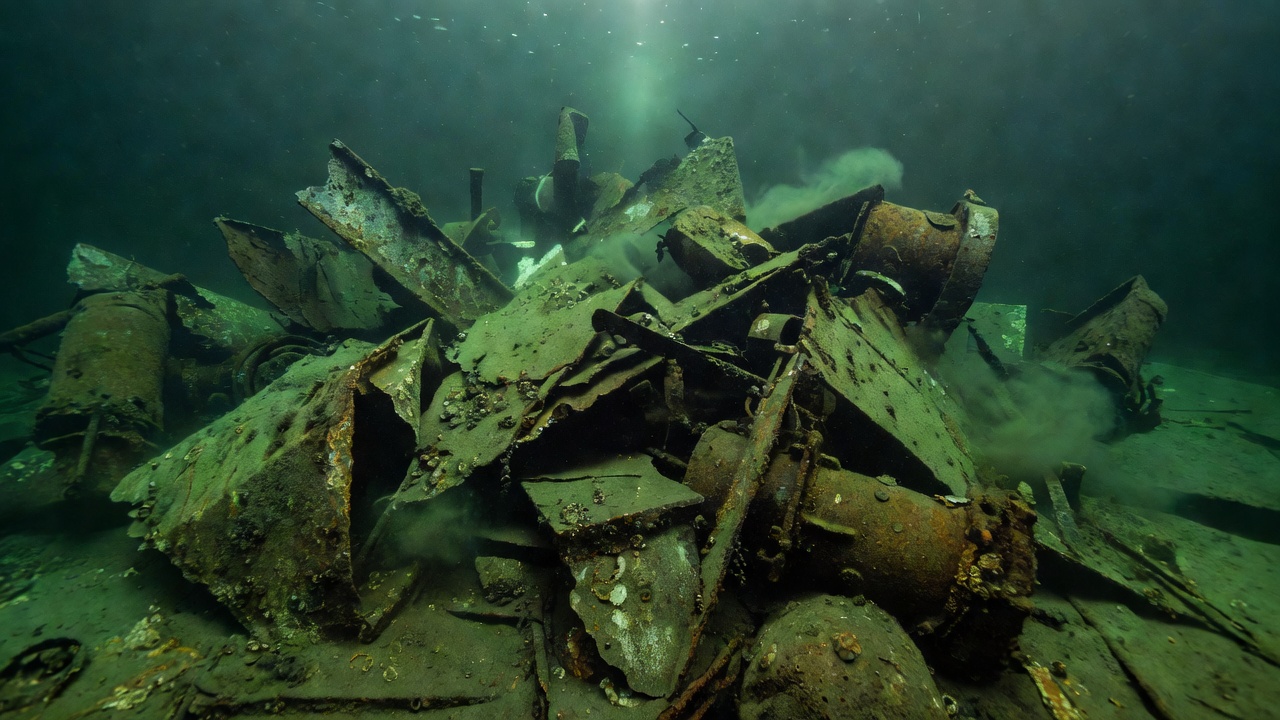
The wreck is in a terrible state of preservation. The shallow depth exposes it to tidal scouring and oxygenated water, accelerating corrosion. Furthermore, the site has been damaged by depth charging during World War II, commercial salvage operations, and the collapse of its own massive superstructure. Today, the Lusitania is a flattened, twisted heap of heavily oxidized steel, barely recognizable as the majestic greyhound of the seas she once was.